

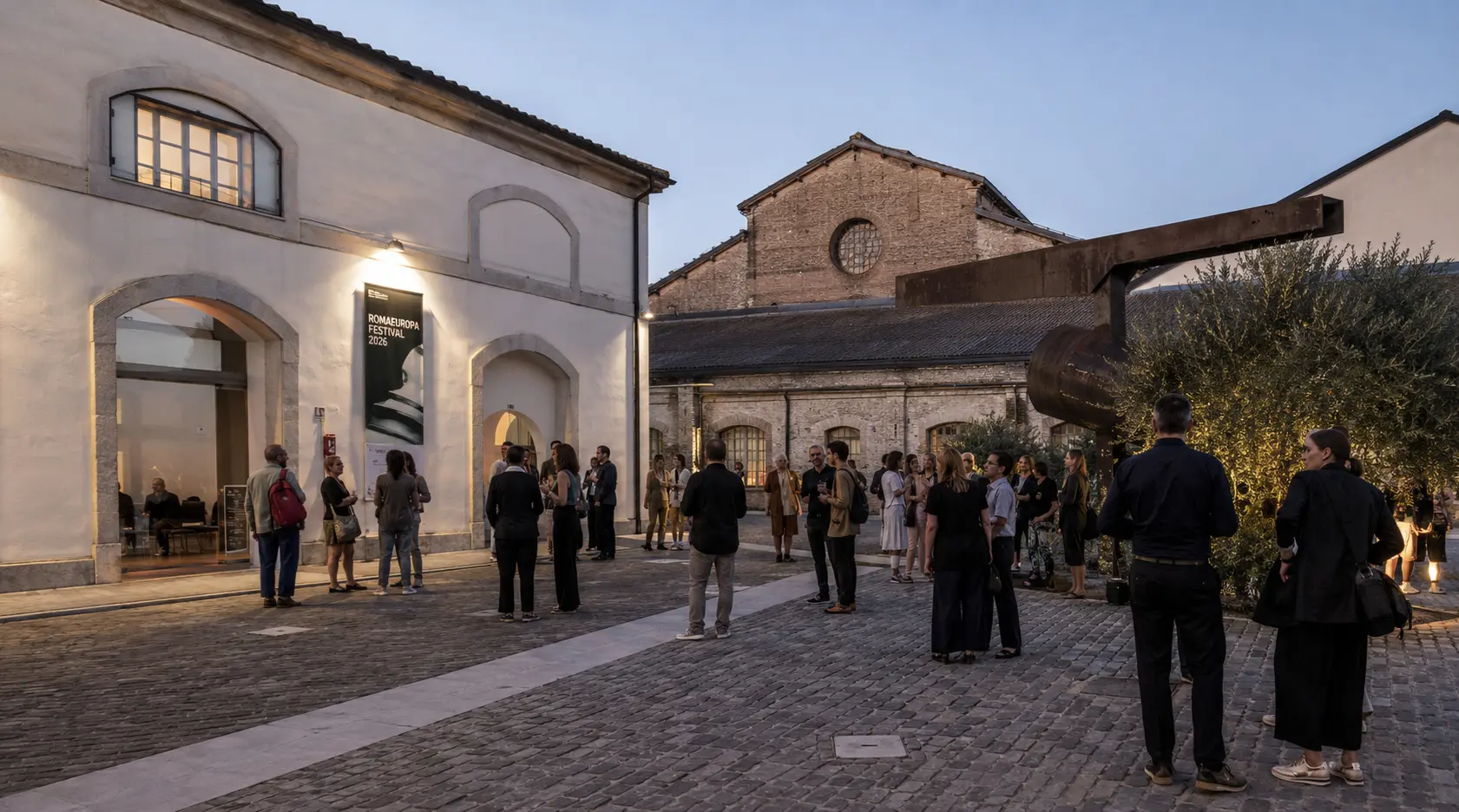
Romaeuropa Festival returns from 8 September to 15 November 2026 with a programme so broad that the real challenge is not finding something to see, but choosing well. The 41st edition brings together dance, music, theatre, digital arts and family projects across roughly twenty venues, with more than one thousand artists and a calendar stretching across Rome for over two months.
For travellers in Rome in September, the festival is particularly useful because it opens a door onto the city beyond the classic monument circuit. One evening might mean the Philip Glass Ensemble at Auditorium Parco della Musica, Jeff Mills with Kety Fusco, contemporary dance at Teatro India, an electronic live set at Mattatoio or a sound project at the American Academy in Rome. This is not one event in one building; it is a network of performances spread through the city.
This guide does not try to summarise every single show. Instead, it selects the most useful September dates, explains how to read the programme, how tickets and the Passepartout work, and how to avoid building an evening that is impossible from a transport point of view. Information checked on 1 September 2026 against the festival’s official channels and Turismo Roma.
When is Romaeuropa Festival 2026?
REF2026 runs from 8 September to 15 November. Turismo Roma describes an edition involving more than 1,000 international artists, around 100 shows, 240 performances and 20 theatres and cultural spaces across the capital. The official Romaeuropa programme presents more than 90 shows and confirms the festival’s genuinely multidisciplinary character.
The opening night on 8 September features Sofia Nappi and KOMOCO at Auditorium Conciliazione with Chora – Il vuoto all’origine / DODI. From there, the language changes almost every night: electronic and contemporary music, choreography, theatre, audiovisual live sets and club-oriented programmes.
September 2026: the dates worth saving
If you are in Rome in September, these are the programme blocks that best show what makes Romaeuropa different from a generic city events calendar.
- 8 September – Sofia Nappi / KOMOCO: festival opening at Auditorium Conciliazione with a double dance programme.
- 9 September – Caterina Barbieri, Christian Marclay and ONCEIM Orchestra: composition, electronics and sound research at Auditorium Conciliazione.
- 10–11 September – Nacera Belaza and Valérie Dréville, L’Echo: contemporary performance at Teatro India, a very different setting from Rome’s large concert halls.
- 14 September – Benjamin Millepied, November Ultra and Paris Danse with SUMMERLAND at Auditorium Conciliazione.
- 15 September – Fatoumata Diawara, Massa Live: Sala Santa Cecilia at Auditorium Parco della Musica, 9 p.m. Official prices are listed from €20 to €40.
- 16 September – The Philip Glass Ensemble with Godfrey Reggio’s Powaqqatsi: a cine-concert at Auditorium Parco della Musica, 9 p.m., with tickets listed from €20 to €40.
- 17 September – Jeff Mills and Kety Fusco, The Trip To Vega: electronics, harp and a cosmic visual world at Auditorium Parco della Musica.
- 18–20 September – Christos Papadopoulos and Georgios Kotsifakis, Landless: dance at Teatro Vascello, with the festival listing a €35 ticket.
- From 19 September – Ultra Club at Mattatoio: Romaeuropa shifts scale and atmosphere again, moving into avant-pop, electronic live sets and more nocturnal performance formats.
- 27 September – OSMIUM with Hildur Guðnadóttir, James Ginzburg, Rully Shabara and Sam Slater: Italian premiere at Teatro Argentina, combining sound performance, custom-built instruments, voice and technology.
How to choose without getting lost in the programme
The least useful way to approach the festival is to book only by recognising the biggest name. Romaeuropa works better if you first decide what kind of night you want: a concert in a major hall, contemporary dance, a more experimental performance, electronic music or a hybrid project.
If this is your first Romaeuropa, a more immediately readable production can be a good starting point: Fatoumata Diawara, Powaqqatsi with the Philip Glass Ensemble, Jeff Mills or one of the opening nights. If experimental work is the reason you are interested in the festival, Mattatoio, Teatro India and the Ultra REF sections tend to offer the less conventional options.
Duration also matters. A 50- or 90-minute event can leave room for dinner before or after. A more complex evening should be treated as the main event of the day, not squeezed in after an already overloaded sightseeing schedule.
Tickets and Passepartout: how it works
Ticket prices vary by performance. The official programme lists, for example, €20–€40 for Fatoumata Diawara and Powaqqatsi, €35 for Landless, and different prices for other productions. Always check the individual event page before buying.
If you plan to see several shows, Romaeuropa offers a Passepartout system based on “coins”: €80 buys 10 coins, €160 buys 20, up to €400 for 50 coins. Each event has a value between 1 and 7 coins, and the Passepartout is personal, so it can be used for only one ticket per event.
The Romaeuropa Foundation recommends buying only through its direct channels or authorised sellers listed by the festival, including Vivaticket and TicketOne. That matters most for higher-demand performances.
The venue matters almost as much as the show
Romaeuropa does not live in one neighbourhood. Auditorium Conciliazione, Auditorium Parco della Musica, Teatro India, Teatro Vascello, Mattatoio, Teatro Argentina and the American Academy in Rome are only some of the September venues. This is one reason the festival can also become a different way of reading the city.
The practical consequence is simple: check the venue before booking dinner or an evening activity. A performance at Mattatoio combines naturally with Testaccio or Ostiense; a concert at Auditorium Parco della Musica has completely different logistics; Teatro India requires another plan again. The same start time does not mean the same evening.
For a wider overview of the month, start with Rome in September 2026: What to Do, Events and Exhibitions, which places Romaeuropa alongside the city’s other major September dates.
How to build a Romaeuropa night without rushing across Rome
The most useful rule is to leave real margin before the performance. If your ticket is for 9 p.m., do not schedule a museum on the other side of the city until 7:30 and assume Rome will provide zero traffic, diversions or waiting time. Use the afternoon in the same area or leave a proper break before the show.
For Mattatoio events, dinner in Testaccio or a walk around Ostiense makes sense. For Auditorium Parco della Musica, think Flaminio and the northern side of the centre instead of crossing the city after dinner. For Auditorium Conciliazione, Vatican, Prati and the Historic Centre are much easier combinations.
If you want to structure the rest of the day around the city itself, walking tours in Rome can work well before an evening performance, as long as the route stays reasonably close or leaves enough time.
If you would rather connect the night with dinner or a food-led experience, look at food tours in Rome, particularly for evenings around Testaccio, Ostiense or central Rome.
When concierge support can help
Romaeuropa is a good example of how travel becomes logistical once you combine performances, restaurants, transfers and timed visits. concierge services in Rome can help when several practical elements need to fit together, while bookings in Rome is the more direct page for restaurant, event and reservation coordination.
The point is not to turn Romaeuropa into a tourism package. The festival is an independent cultural programme. Support is useful only for reducing friction around the performance itself.
Is Romaeuropa Festival worth one night of your trip?
Yes, especially if you want to see a contemporary side of Rome rather than building the entire trip around antiquity. The festival lets you experience the city as a place producing culture now, with international artists, very different venues and formats ranging from concerts and dance to cine-concerts and electronic performance.
You do not need to chase the maximum number of events. It is better to choose one performance that genuinely fits your interests and build a simple evening around it. In a festival this broad, selection is part of the experience.
Quick FAQ
When is Romaeuropa Festival 2026?
From 8 September to 15 November 2026, with events spread across numerous cultural venues in Rome.
Where does it take place?
There is no single venue. September locations include Auditorium Conciliazione, Auditorium Parco della Musica, Teatro India, Teatro Vascello, Mattatoio, Teatro Argentina and the American Academy in Rome.
How much are tickets?
It depends on the show. Some September events are listed at €20–€40, while others have different prices. Check the official page for the specific performance.
Is there a festival pass?
Yes. The Passepartout uses coins that can be redeemed for festival events, with packages starting at €80 for 10 coins.
Is it suitable if I do not usually follow contemporary art?
Yes, but choose according to your interests. Concerts, cine-concerts and artists you already know may be better entry points than booking an experimental performance at random.
External sources
- Romaeuropa – Festival 2026 programme – https://romaeuropa.net/en/festival-2026/
- Romaeuropa – Box Office and Passepartout – https://romaeuropa.net/en/box-office/
- Turismo Roma – Romaeuropa Festival REF2026 – https://www.turismoroma.it/en/events/romaeuropa-festival-ref2026
- Romaeuropa – Official 2026 programme PDF – https://romaeuropa.net/wp-content/uploads/2026/04/Programma_REF2026.pdf
information checked on 1 September 2026. Times, prices and availability may change; always verify the official event page before purchase.